Bio: Alberto Aguilar wrote this biography but will be speaking in third person. For no specific reason he has omitted the word art from this short paragraph but has made one exception. Alberto is a Chicago based ___ist and teaches at Harold Washington College. He is coordinator of Pedestrian Project a program dedicated to making ___ more accessible and available to all. Currently he is ___ist in residence at the ___ Institute of Chicago. Aguilar's creative practice often incorporates whatever materials are at hand as well as exchanges with his family, other ___ists, and people he encounters. His work bridges media from painting and sculpture to video, installation, performance, and sound, and has been exhibited at Chicago’s Museum of Contemporary ___, the Queens Museum, Crystal Bridges Museum, the Nelson-Atkins Museum and the Minneapolis Institute of ___.
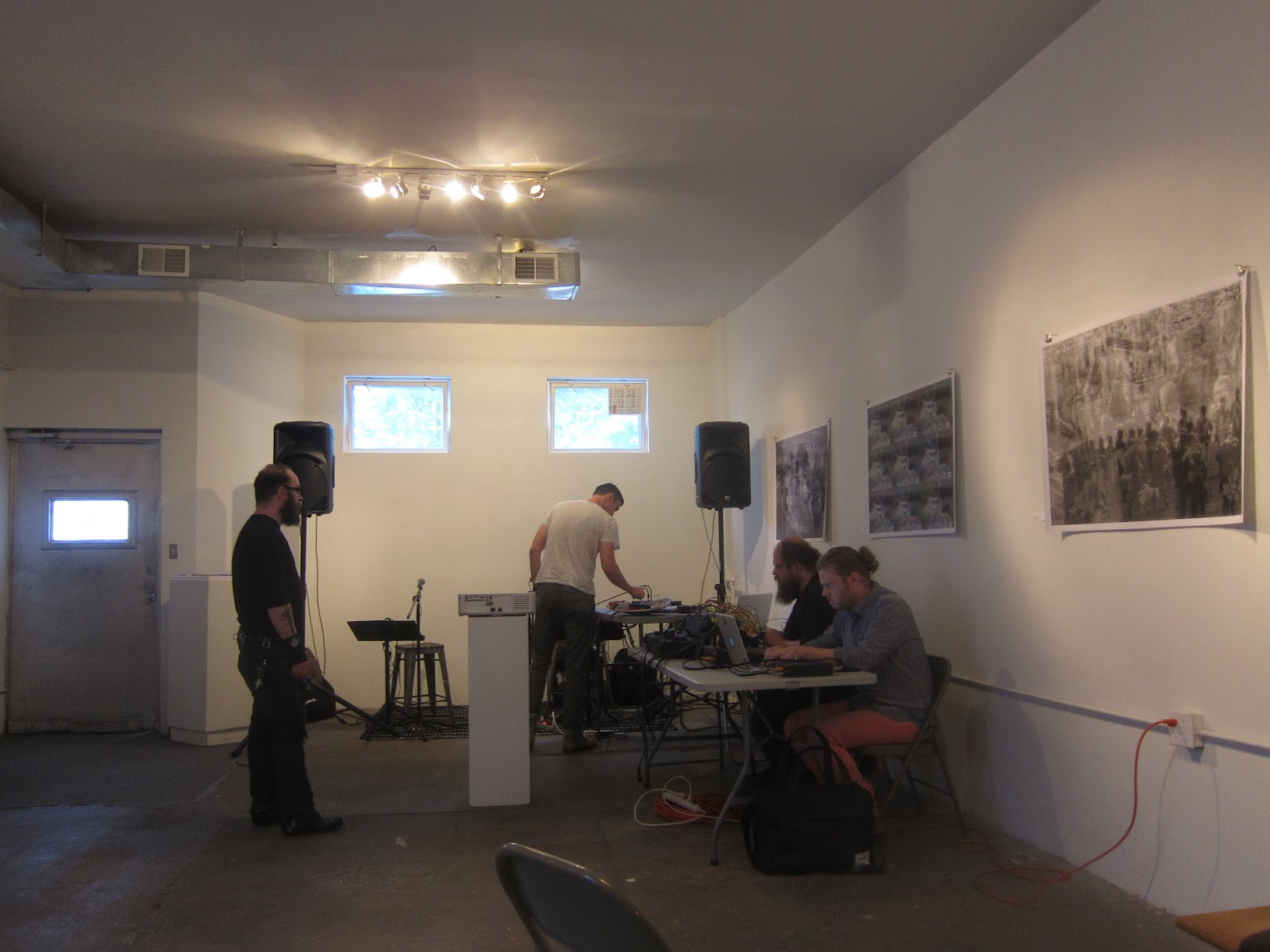
Hot for O.S. is a tongue in cheek title for a show with artists who work with new technology. While we all are staring at our phones and tablets during our bus or train trips, these artists use new media and create artwork that is unique and challenge the norms of how we experience art.
Regarding the title, O.S. or Object Sexuality is a sexual fetish for people who fall in love or feel strong feelings of attraction to inanimate objects. Although these artists are not necessarily in love with their objects(or are they?), they do have a passion.
About the artists:
Amanda Gutierrez is a video artist born in Mexico City, Amanda Gutiérrez completed her graduate studies at The School of the Art Institute of Chicago, specializing in Performance and New Media. In Mexico, she completed her undergraduate studies in Stage Design at the INBA/ENAT. For twelve years, she has worked in the field of performance and sound art, fusing the two disciplines in installation projects. Among her video series is A brief history of fictions, which consists of four projects performed under the same methodology and work strategies from documentary and performance. This series has won two awards: The Fellowship Competition 2007 and CAAP 2008, and was selected as a finalist for the national award Artadia Art Chicago 2009. Gutiérrez has had artist residencies at CMM (Multimedia Center) in Mexico City, Mexico (2001), ZKM (Zentrum für Kunst und Medientechnologie) in Karlsruhe, Germany (2002), and Artist Village in Taipei, Taiwan (2009). She has also received scholarships from the Artist Residencies Program 2009 FONCA-BANFF Centre and the prize-EMARE EMAN at the residency FACT Liverpool. In the present she is the recipient of the Mexican grant for established artist: Sistema Nacional de Creadores ( National System of Creators). www.amandagutierrez.net
Amelia Winger-Bearskin is graduating from NYU – ITP (Interactive Telecommunications Program) in New York City in 2015 ( PBS MediaShift). In 2014 her video artwork was included in the 2014 Storytelling : La biennale d’art contemporain autochtone, 2e édition (Art Biennale of Contemporary Native Art) at Art Mur (Montreal, Canada). She is also the co-founder of the ‘Stupid Hackathon’ with Sam Lavigne-in its second year and has had press in a few recent publications, most recently The Guardian. She has been a featured artist at numerous international performance festivals since 2008 in cities not limited to: Beijing, China, Manila, Philippines, Seoul, South Korea, Sao Paulo, Brazil, New York NY and Washington, DC. She performed as part of the 2012 Gwangju Biennial and created an interactive portion of The Exchange Archive at the Museum of Modern Art (MoMA) in 2013. http://studioamelia.com
Brett Ian Balogh is a Chicago-based artist working at the intersection of objects, sounds and spaces. He is currently an instructor at the School of the Art Institute of Chicago, the University of Illinois at Chicago and the Illinois Institute of Technology, teaching courses in new media, architecture, digital fabrication, radio and sound. Brett is a free103point9 transmission artist and has exhibited and performed at P.S.1 (NY), Diapason (NY), Devotion Gallery (NY); The MCA (Chicago) and The Hyde Park Arts Center (Chicago) among others.
David Tracy is a designer and artist currently residing in New York City by way of Chicago. David worked as an architect in Chicago before pursuing a Master’s degree at the Interactive Telecommunications Program at NYU. He develops projects that explore the digital presence of physical objects, internet augmented perception, and interactive space.
George Monteleone was born in Philadelphia and grew up in the rural enclave of Jim Thorpe (formerly known as Mauch Chunk), Pennsylvania. He studied cognitive science at Northwestern University, and developed his creative practice at the School of the Art Institute of Chicago and the Skowhegan School of Painting and Sculpture. His work explores potential structures of social and affective experience, which he considers a specialized inquiry in the field of science, and a fundamental component in the practice of art. He has screened, performed, and exhibited collaborative work at venues including The Kitchen (New York City, NY), Recess (New York City, NY), The Edinburgh International Film Festival (Edinburgh, Scotland), The Crossroads Moving Image Festival (San Francisco, CA), Roots & Culture CAC (Chicago, IL), and The Hyde Park Arts Center (Chicago, IL). He has also co-authored research articles published in the Proceedings of the National Academy of Sciences, the Journal of Personality and Social Psychology, and the Journal of Cognitive Neuroscience. He currently resides in New York City, makes ongoing remote contributions to research at the University of Chicago Center for Cognitive and Social Neuroscience, and teaches in the program in Digital Arts and Multimedia Design at La Salle University as well as the Department of Film at Brooklyn College.
Hương Ngô is an interdisciplinary artist, born in Hong Kong as a refugee and based everywhere. Her work draws from a range of performance-based practices in order to engage specifically with the potential of the anti/de-colonial gesture and more broadly to explore how political agency is embedded in the performative. A graduate of the School of the Art Institute of Chicago, she was a fellow at the Whitney Independent Study Program and recently received the Fulbright U.S. Scholars Grant to realize a project in Vietnam. She has presented her solo and collaborative work at the Museum of Contemporary Art (Chicago, IL), the Yerba Buena Center (San Francisco, CA), the New Museum (New York City, NY), Momenta Art (Brooklyn, NY), Vox Populi (Philadelphia, PA), the Queens Museum (Queens, NY), The Kitchen (New York City, NY), Madison Museum of Contemporary Art (Madison, WI), the Tate Modern (London, UK), the National Gallery (Prague, CZ) through the 2005 International Prague Art Biennial, amongst many other artist-run and nonprofit spaces. She is the recipient of the 2011 Rhizome Commission (with Fantastic Futures), has been in residence through the Lower Manhattan Cultural Council (New York City, NY), SOMA (Mexico City, MX), and the Camargo Foundation (Cassis, FR). This summer, she will be in residence at Latitude (Chicago, IL) and Millay Colony (Austerlitz, NY). http://www.huongngo.com/
Jason Soliday is an electronic musician who has been an active member of Chicago’s sound-making community for over fifteen years, performing improvised and semi-composed works as a solo artist as well as a member of various bands and collaborative projects. Current projects XTAL fSCK with new media/glitch artist Jon Satrom, Cleaved Clever with Jake Rodriguez (bran(…)pos), several recording projects with EVP researcher Michael Esposito, and an improvising duo with bassist Darin Gray (Chikamorachi, Dazzling Killmen, etc.). From 2005 to 2012 he was also the main organizer at Enemy, a performance space in Chicago focusing on sound art and improvised music. www.soundcloud.com/cranks-satori
Jeff Kolar is a sound artist and curator working in Chicago, USA. His work, described as “speaker-shredding” (Half Letter Press), “wonderfully strange” (John Corbett), and “characteristically curious” (Marc Weidenbaum), often activates sound in unconventional, temporary, and ephemeral ways using appropriation and remix as a critical practice. His solo and collaborative projects, installations, and public performances often investigate the mundane sonic nuances of everyday electronic devices. Jeff is a free103point9 Transmission Artist, and the founder and director of Radius, an experimental radio broadcast platform. http://jeffkolar.us
Jon Satrom is a constructive deconstructivist, a creative problematizer, a collaborative agitator and a systems spelunker. His realtime A/V performances (w/ Jason Soliday & Rob Ray, && others), experimental video-works, net.art, and artware (w/ Ben Syverson) have been consumed within various space-times across multiple planes. Satrom co-founded the r4wb1t5! microFestival framework (w/ jonCates) and the GLI.TC/Hconference/festival/gathering (w/ Nick Briz, Evan Meaney, && Rosa Menkman). He has taught and developed courses in the new-media path of the Department of Film Video New Media Animation at the School of the Art Institute of Chicago, the TECHNE lab at the University of Colorado in Boulder, and directs the Chicago-based boutique digital studio studiothread. Sharing, bringing folks together, creative problem creating and investigating structures though failure, kludges, and glitches fuel his endeavors. http://jonsatrom.com
Patrick Lichty is a technologically-based media artist, writer, independent curator, co-founder of the performance art group Second Front, and animator for the activist group, The Yes Men. He began showing technological media art in 1989, and deals with works and writing that explore the social relations between us and media. Venues in which Lichty has been involved with solo and collaborative works include the Whitney & Turin Biennials, Maribor Triennial, Performa Performance Biennial, Ars Electronica, and the International Symposium on the Electronic Arts (ISEA). http://patricklichty.com/
Patrick Quinn is an artist, hacker and researcher concerned with destabilizing structures of enclosure and promoting open culture. He utilizes a variety of remixological processes and trangressive media strategies to form a tangential counter-discourse to capitalism. This counter-discourse takes the form of participatory media art projects that attempt to inspire widespread revolt against commodified information and move society beyond the property form. In 2015, Quinn founded SURVANT-Cryp (https://twitter.com/survantcryp), a Brooklyn-based experimental music + zine imprint utilizing dead drops + .onion sites to distribute music + zines + poetics. He has participated in art + hacking projects in Chicago, New York, San Francisco, Detroit, Dallas, Basel and Cape Town. Quinn studied at the School of the Art Institute of Chicago and received a Master of Fine Arts degree from Vermont College of Fine Arts in 2015.
Paul Hertz is an independent artist and curator who teaches at the School of the Art Institute of Chicago. He delights in dysfunctional fortunetelling, faux symbolism, intermedia, code sourcery, glitching and social interfaces. He recently curated the group show "glitChicago" at the Ukrainian Institute of Modern Art. Another group show he curated, all.go.rhythm, will open at the Ukrainian in October 2015. He has been involved with algorithmic art and computational media for over 30 years. http://paulhertz.net/
Sam Lavigne is an artist and programmer based in Brooklyn. His work deals with surveillance, cops, data, and automation. He is a contributing editor at The New Inquiry, and the cofounder of the Stupid Shit No One Needs and Terrible Ideas Hackathon. http://lav.io
_ʝ⌡△✕✕✕5̶¥̶N̶_ is the Noise Country duet of jonCates && 愛真 Janet Lin, who got married in a fever, hotter than a pepper sprout: jJ4xxx5YN.tumblr.com About the curator:
Miguel Cortez is an artist/curator living in Chicago and born in Guanajuato, Mexico. He has studied filmmaking at Columbia College and art at the School of the Art Institute of Chicago. He currently runs Antena, an alternative art space located in Chicago's Pilsen neighborhood. His artwork has been shown at Gallery 414 in Fort Worth, Texas, at the Krannert Museum and at the National Museum of Mexican Art in Chicago. Other shows include exhibits in Dallas at Mighty Fine Arts Gallery, Glass Curtain Gallery and at VU Space in Melbourne, Australia. http://www.mcortez.com/
"antena" is a project space located in Chicago's Pilsen neighborhood. The spanish word "antena" means a device that is a transducer designed to transmit or receive electromagnetic waves but in this case it is meant to define it as a cultural space that transmits/broadcasts symbolically art ideas, new media and installation projects on a local and global scale.